Domain expertise, taste, AI fluency — the three capabilities, and the three gaps.
A senior operator post‑2024 needs three things, not one. Each is hard‑earned. None substitutes for another. The interesting people I work with have all three — and the people I most enjoy hiring are the ones who know which of the three they're still building.
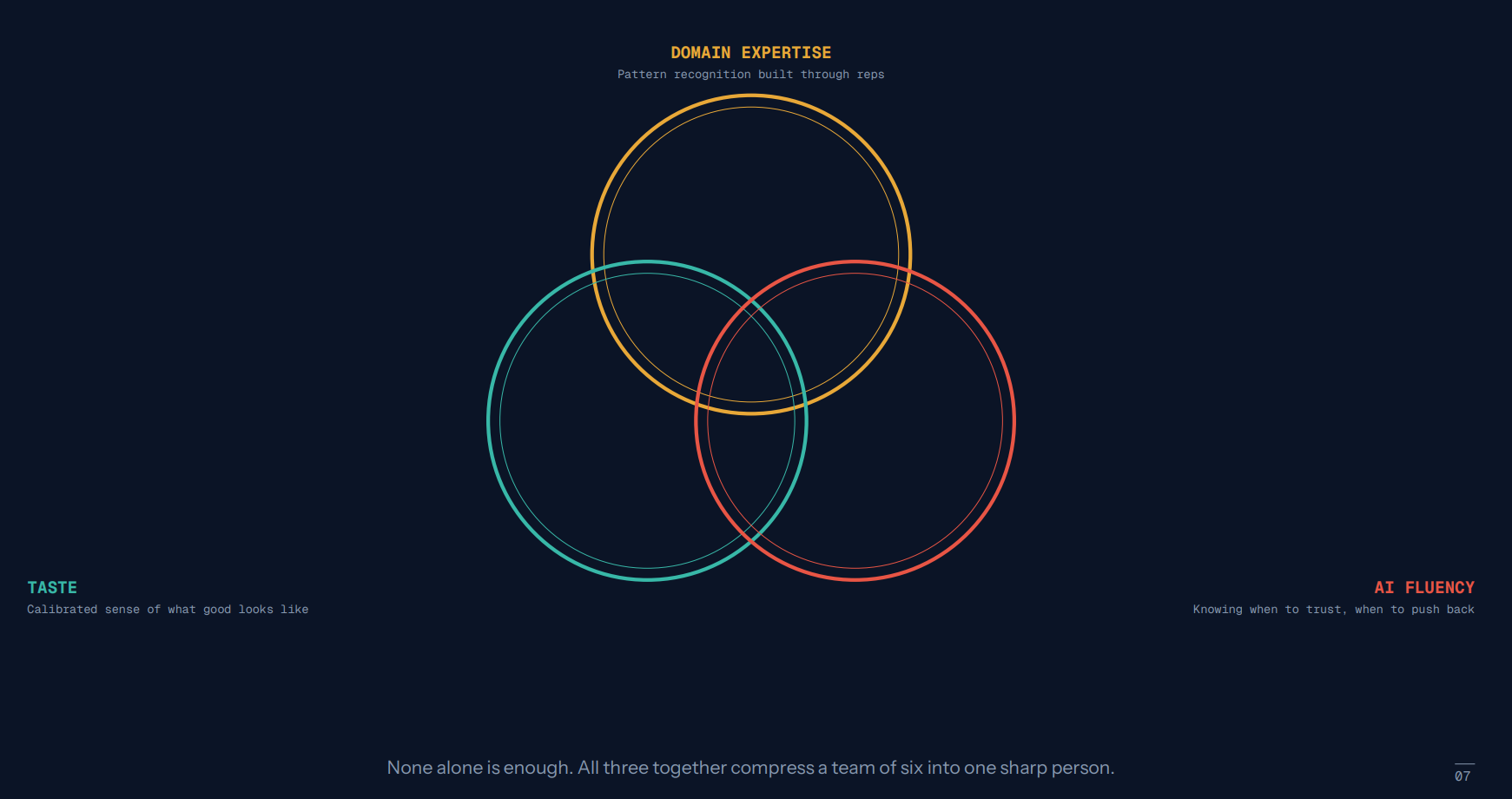
Capability one — domain expertise.
Pattern recognition built through reps. The reason ten years in FMCG matters is not the trivia — it's that you've seen pricing collapse, channel conflict, a launch that died in week three, a category leader pivot at the wrong moment. You know what a healthy P&L looks like in this category, and you can feel when one is rotting.
This is the capability AI cannot synthesise. The model has read everything, but it has not lived through anything. When a CFO tells me their margin is "fine," domain expertise is what tells me which question to ask next. The model can list ten questions; experience is what picks the right one.
Capability two — taste.
A calibrated sense of what good looks like. Taste is what stops you shipping the AI's first draft. It's the editor's eye that says this is generic, the data is right but the framing is wrong, the chart is doing too much, the tone is off for this audience.
Taste is built the same way as domain expertise — reps and exposure — but to a different signal. You build domain expertise by working in the domain. You build taste by paying close attention to work you admire and asking why it's good. McKinsey trained mine by forcing me to sit in rooms where partners would rip apart a deck word by word. The painful part wasn't the criticism; it was watching someone else's brain notice the things mine had skipped.
Capability three — AI fluency.
Knowing when to trust the model, when to push back, and how to compose multiple agents into something larger than what any single prompt can produce.
This is the newest of the three, and the one most people are catching up on. AI fluency is not "I use ChatGPT" — that's the keyboard equivalent. Real fluency is the layer above: when do I one‑shot, when do I scaffold a multi‑step plan, when do I deliberately let the model fail so I can see where its blind spot is, when do I run two agents against each other and pick the better answer.
The three failure modes when one is missing.
Each missing capability has a distinct shape:
Failure 1Domain + taste, no AI fluency.
The classical senior operator. Excellent judgement. Slow. Doing in a week what a junior with AI fluency does in a day. They're right, but they're being out‑shipped — and at some point the gap stops being recoverable.
Failure 2Taste + AI fluency, no domain depth.
This is the one I call beautiful arrows shot into the air. The output looks great. The framing is sharp. The model is well‑prompted. But it's pointed at the wrong target because the operator doesn't know enough about the actual business to see that the wrong question is being answered. Painfully common right now.
Failure 3Domain + AI fluency, no taste.
The expert who can ship volume but can't tell what's worth shipping. They produce ten decks where one would do, six prototypes where one well‑edited one would land. AI gives them force without the editorial hand to focus it. Often technically excellent and yet somehow the work doesn't move.
What I'm actually hiring for.
I now ask candidates which of the three they're newest at, and what they're doing about it. The answer tells me more than a CV. Someone who says "I've got domain depth from ten years at X, my taste is decent, and I've spent the last six months grinding AI fluency by rebuilding our internal workflow with Claude Code" — that person is in the rare middle of the diagram. They're worth their weight.
Someone who answers the question with confusion is missing self‑awareness, which is its own fourth capability and the meta‑gate to the other three.