Force × direction — what AI actually amplifies in strategy work.
Every strategic problem is a vector. AI gives you almost free force. The work — and the moat — is in the direction. Better to go in the right direction slowly than the wrong direction fast.
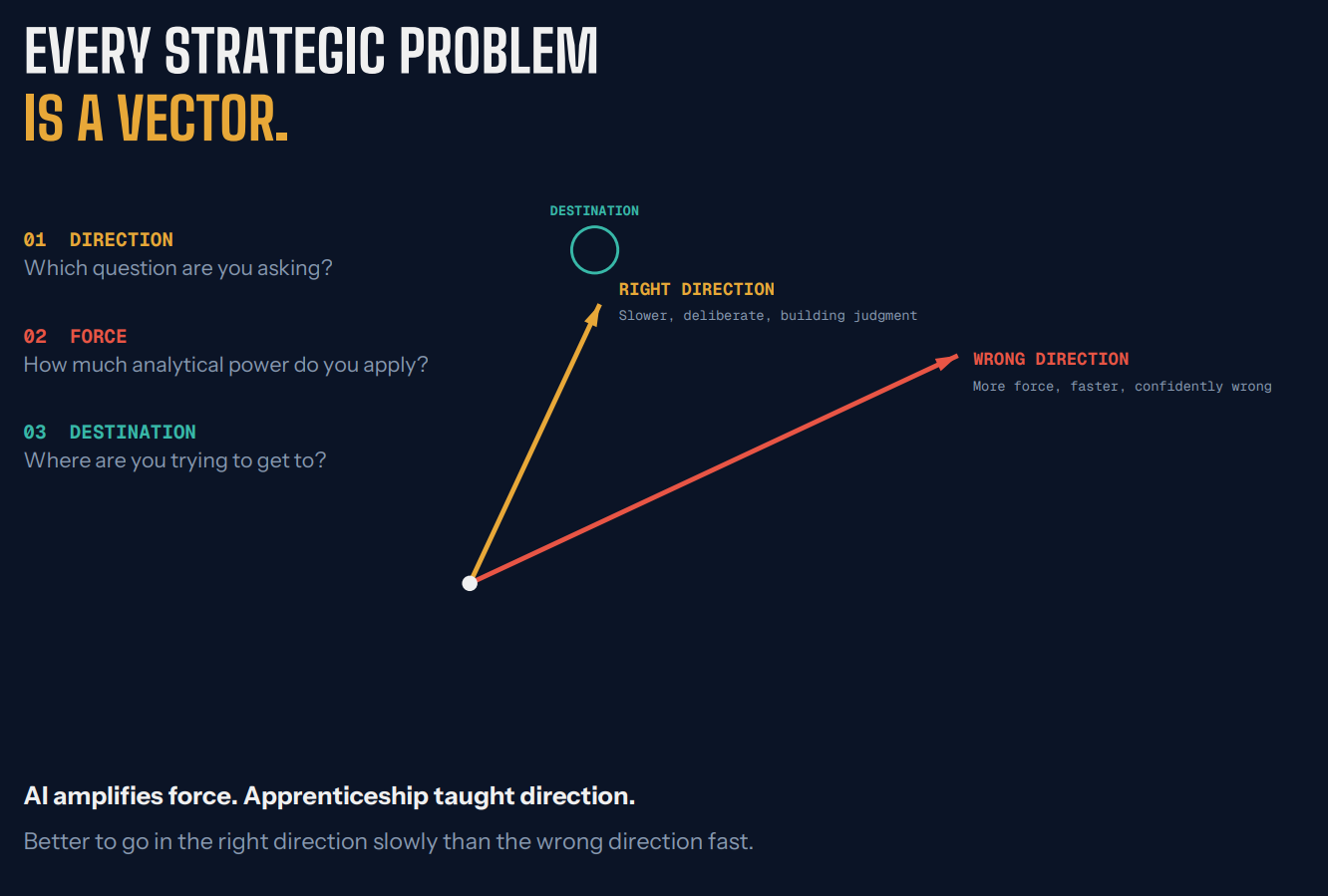
Strategy looks like a series of slides, but underneath every slide is a vector. Three components, in this order:
- Direction — which question are you actually asking?
- Force — how much analytical horsepower do you put behind it?
- Destination — where are you trying to get to?
Until 2023, force was the bottleneck. Smart, expensive humans took weeks to gather, model, synthesise, and present. The reason consulting cost what it did was because raw analytical force was scarce.
That bottleneck is gone. With Claude Code or a good agent stack, force is almost free. A first‑draft deck, a benchmarking sweep, a model template — these are now overnight outputs. The economics of force have collapsed.
So what is left?
What's left is the direction. And direction does not get cheaper with AI. If anything, it gets more expensive — because you can now move at full speed in whichever direction you happen to point at.
That's the failure mode I see in every team I work with. Junior analysts who used to take a week to grind out an answer can now produce one in an hour. The output looks polished. It moves. It compiles. It even reads well. But if the question underneath was wrong, all that polish does is make the wrong answer easier to ship.
The work the AI can't touch.
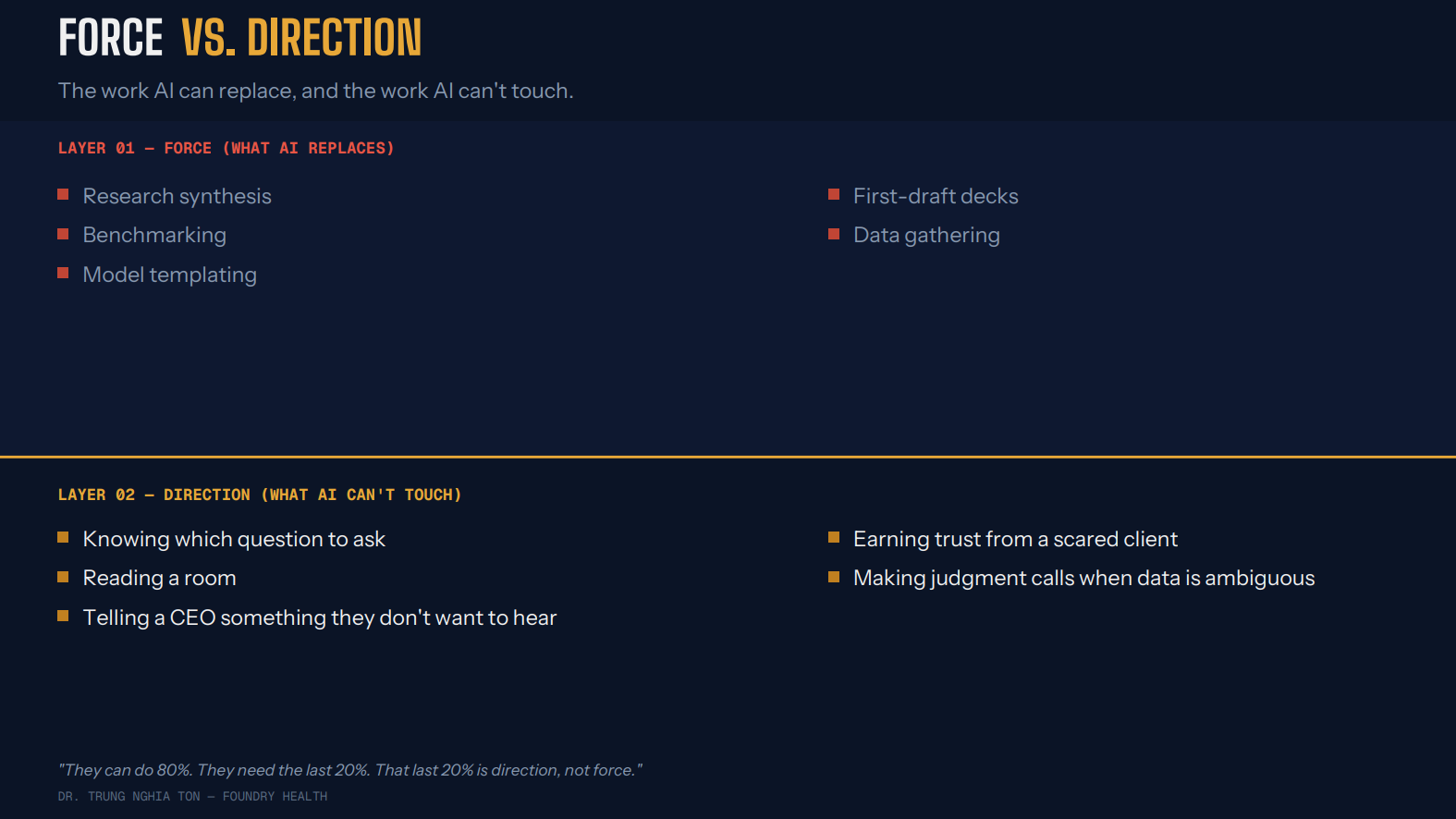
The lecture I gave at UNSW broke the work into two layers:
Layer 1 — force. Research synthesis, benchmarking, model templating, first‑draft decks, data gathering. AI replaces this. Not augments — replaces.
Layer 2 — direction. Knowing which question to ask. Reading a room. Telling a CEO something they don't want to hear. Earning trust from a scared client. Making a judgement call when the data is genuinely ambiguous. AI does not touch this layer. Not because the models aren't smart — they are — but because the work is fundamentally about being a person another person trusts to make a call.
Where this changes how I work.
If force is free, my entire week reorganises. Mondays used to be about briefing the team and watching the gears engage. Now Mondays are for direction work — sitting with the problem, walking the office, talking to the operator who actually runs the channel. The thinking I used to compress into the gaps between meetings now is the work.
The deliverables come almost as a by‑product. By Wednesday I can produce a deck, a model, a brief — but only because by Tuesday I knew exactly what question I was answering, and I'd already pressure‑tested it with the people who'd live with the consequences.
The teams that flounder are the ones where AI fluency arrived before direction discipline. They've automated the wrong half of the job and called it productivity.