AI doesn't disrupt analysis. It disrupts the apprenticeship.
The headline that AI is "killing consulting" misreads what's actually happening. The analysis layer hasn't been hollowed out — the apprenticeship layer has. And that's the layer that used to manufacture judgement.
I gave a guest lecture at UNSW in April 2026 — my own undergraduate program, where I'd been a Co‑op scholarship student a decade earlier. The audience was final‑year BIS students about to graduate into a labour market that looked nothing like the one I'd entered.
The question they wanted answered was simple: is consulting still a real career, now that AI can do what we'd be hired to do?
I told them the question is the wrong shape. AI hasn't killed consulting. It has completely changed the apprenticeship model that made consulting what it was.
The four reflections.
Walking into the lecture, I distilled it to four things:
- AI hasn't killed consulting — it has completely changed the apprenticeship model that made consulting what it was.
- Consulting hasn't been disrupted by better analysis — the signal‑to‑noise ratio has gone down.
- The economics of consulting are being re‑written from traditional pyramid models.
- The ladder that built business judgement has become harder to find.
What the pyramid was actually doing.
The classical consulting pyramid — partners on top, EMs in the middle, associates and analysts at the base — looked like a pricing structure. It was, but that was a side effect. The real function of the pyramid was an apprenticeship.
I learned strategy by working a 2018 market entry case under an EM and a partner who would course‑correct me twice a day. Day 1 I produced an answer. Day 2 the EM tore it apart and gave me direction. Day 3 the EM redirected again as new evidence came in. Day 4 the partner adjusted the framing for the boardroom. By the time we reached the steering committee in week one, my Day 1 answer had been reshaped four times by people whose judgement I was inheriting through the work itself.
That apprenticeship was the product. The deck the client paid for was the by‑product.
What AI did to that.
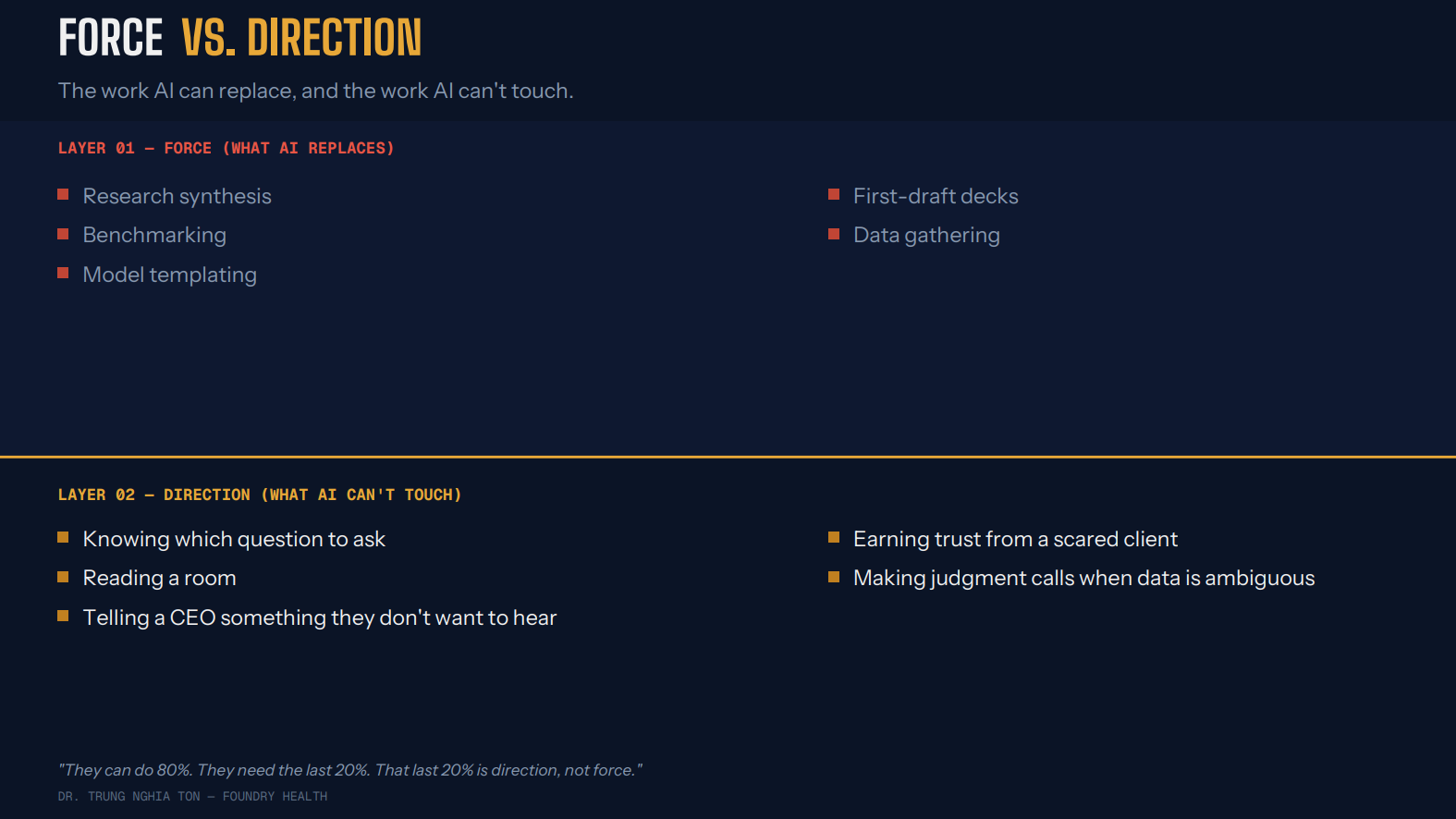
AI compressed the analyst's week of work into an evening. The Day 1 answer is now a pretty good answer — by traditional standards. The slides are clean, the model is reasonable, the synthesis is coherent. By the old metric of "how good is the analyst's first draft," AI has been transformative.
But the apprenticeship lived in the distance between the Day 1 answer and the steering committee answer. That distance is what taught me what good looks like. It's where I learned the difference between analysis and judgement. And that distance is exactly what AI has shortened — not by improving the final answer, but by lifting the floor of the first answer.
What partners are actually telling me.
I called around — a managing partner at an AI boutique who's an ex‑McKinsey partner, an associate partner still inside, a former partner now at a tech‑first venture studio, a couple of alumni now running their own shops. The pattern was consistent enough to write down:
"We've had to evolve our RAG, skills, and customisation of any LLM quickly to ensure the quality of our work — you need to be much better at QA."
"You still need to learn the basics of research, problem formulation, testing, and presenting before relying on LLMs. Otherwise it's a lot of slop."
Why this is a generational problem.
If you were a partner in 2015, your judgement was forged through reps that no longer exist. The case team you ran taught the team under you the same way. The pipeline assumed time on the tools as the path to taste.
If you graduate in 2026, your time on the tools is being aggressively shortened. The model can do the spreadsheet, the synthesis, the first draft. You can spend the saved time on judgement work — but only if you know what judgement work looks like, and you typically only know that because someone showed you in a room.
The risk isn't that the analyst job disappears. The risk is that the analyst job survives but stops manufacturing partners, because the rungs that built judgement have been quietly removed and the building still has a top floor.
What I told the UNSW students to do Monday morning.
Three things, in order:
- Critique, don't just produce. Find three things the AI got wrong before you submit anything. If you can't find any, you don't understand the material yet.
- Build domain depth early. Pick a sector, go deeper than coursework requires, read the industry reports, follow operators not influencers. Domain depth is the one capability that cannot be cloned by the model.
- Start building things. Not assignments — actual things. A project, a tool, a small business. The model makes MVPs possible in a weekend that used to take a team a quarter. Use that.
I left them with one quote that's stuck with me — from a managing partner I respect deeply, an ex‑McKinsey partner now running an AI boutique:
The moat moved up the stack. The apprenticeship has to move with it.