Frollie POS — how a non-technical founder built a real product with AI
How a non-technical, ex-McKinsey founder built a real money-taking product with a swarm of AI agents — in 15 days.
presented at AI Mini-Con and Hackathon — WeWork, 383 George St, Sydney · June 10, 2026
I built a working product from scratch in 15 days
I'm Lucas — seven years at McKinsey, no engineering background. Fifteen days ago this was a planning doc. Today it takes real money at our cookie booth in Jakarta, and I hired no engineers to get there. I'll show you what I built, how I ran AI agents like a team, and the lessons that carry over to any CEO.
what is it? (the value chain)
It looks like a normal cash register. What it actually is: one value chain, top to bottom — from opening a shift to the message that wakes a manager at home. Walk the layers: staff sign in, stock comes in, a sale freezes its own prices, the payment provider confirms the moment money lands, the receipt prints, everything lands on a permanent log, and anything unusual finds a manager on Telegram. (The money-path rules behind layer 4 live in appendix A if anyone asks.)
I never let my own work ship on one pass
The cheapest mistake to fix is believing QA happens by itself because the agents are smart. It doesn't. I built my own evaluation workflows — some qualitative, judging taste and consistency; some deterministic, checks that pass or fail. The plan gets reviewed before anything is built, and finished work goes to three reviewers with three different jobs who never compare notes. You can't outsource taste. You build evaluation systems you trust, and that took me time and millions of tokens of iteration.
one person. a whole org chart.
I didn't write much code — I ran AI agents like a company, split the work, made them check each other against my written rules, and looped until right. Two of the tools on screen are real and public: the Build Log — the progress report I actually read every morning, written for a non-engineer — and shipshape, the QA checklist I run daily. Scan the code; it's on my GitHub. The team I didn't hire saved me the coordination, not just the salary.
five common beliefs I now challenge as an agentic practitioner (click-through)
Each of these felt true on day one. (click) Agentic development is easy — until the demo works and production doesn't. (click) Building alone is hard — wrong kind of hard; the loneliness is in the deciding, not the typing. (click) Consuming AI is the same as building with it — using ChatGPT daily taught me almost nothing about running agents on a real codebase. (click) A better model will fix the quality gaps — it won't; my evaluation workflows did. (click) Build something you can sell — I built something I could run, and the booth taught me more than a pitch deck ever would.
the build was the cheap part
Here's the one that taught me the most. I built the off-site approval system pillar by pillar — each pillar clean on its own, but they talked past each other in time, and some transactions fell through without proper logging. No error. I only found it while building refunds on top. The save was two-fold: better end-to-end testing instructions for my testing agents, and deeper modules behind simpler interfaces — John Ousterhout's "deep modules" idea from A Philosophy of Software Design (I first heard it via Matt Pocock) — so the seams are testable without knowing the internals. You can see that in the chart: the tests more than doubled, but the number of public surfaces flatlined at twelve — depth grew, the interfaces didn't.
this deck built itself
This deck built itself the same way I build features — the same method, pointed at my own notes and the live app. Six agents, a few dollars, a first draft in under five minutes. The pitch about delegation was produced by delegation.
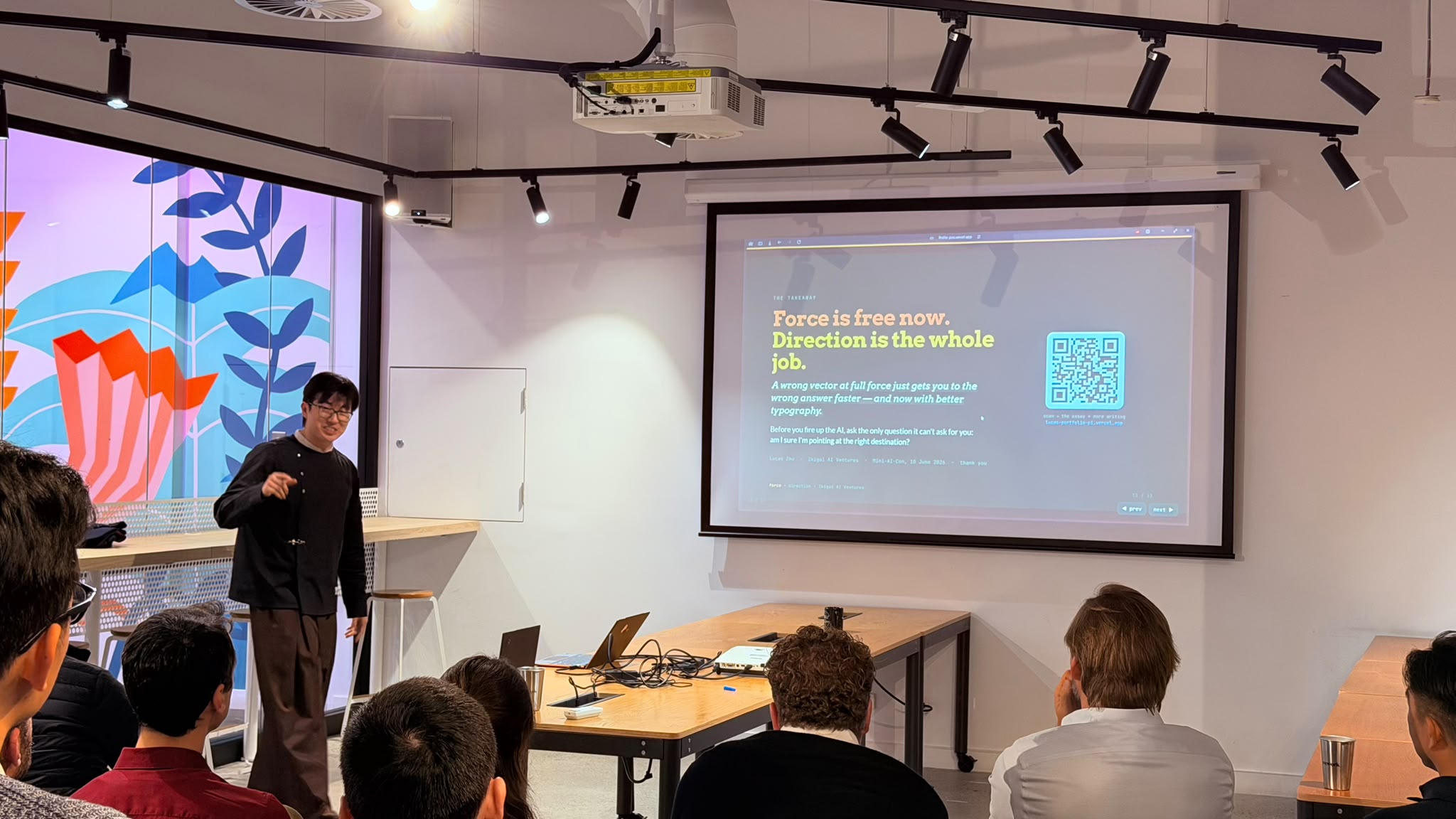
force is free now; direction is the whole job
If you take one thing: AI gives you almost free force, and the moat is direction. It will be confidently wrong, at full speed, if you let it. My whole job now is pointing it at the right thing, and pausing before the confident-wrong answer ships. Thanks.
what holds it together?
The former slide 3, kept verbatim after the close for Q&A: the money path (lock the sale → request payment → provider confirms → mark paid → stock + log) plus the three rules (one rulebook · frozen receipts · press twice, charge once). Pull it up if a peer asks "but how do you know the money is right?"
the rules rewrote themselves
The former slide 6, kept verbatim after appendix A: the five planned → became decision reversals (own system vs shared database · webhook vs polling · Telegram vs WhatsApp · settlement has no notification · the QR that wasn't). Pull it up if asked "what did you get wrong on architecture?"