Force × Direction — what AI actually amplifies in strategy work
AI gives you almost free force. The moat is direction — and a wrong vector at full force just gets you to the wrong answer faster.
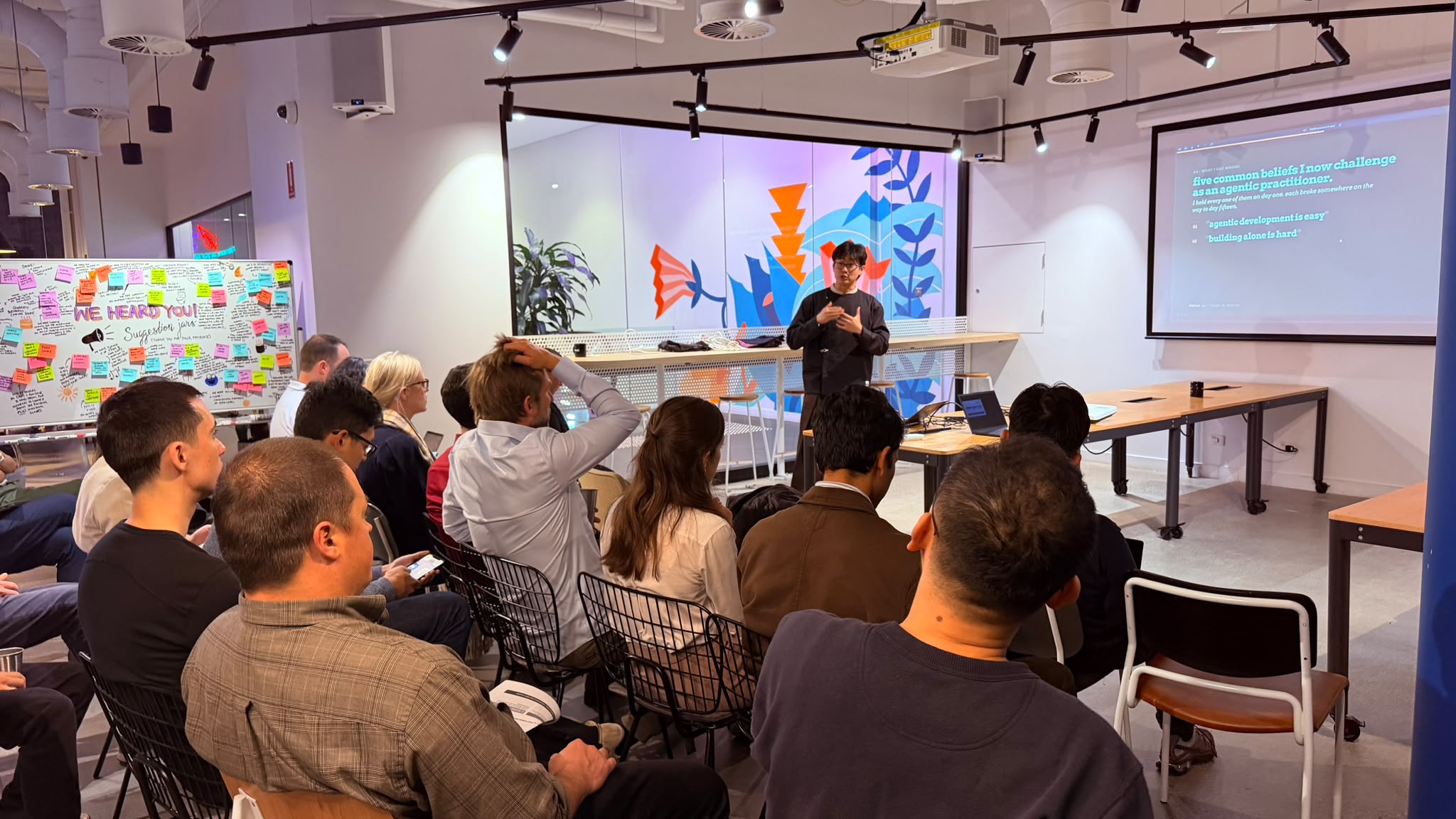
presented at AI Mini-Con and Hackathon — WeWork, 383 George St, Sydney · June 10, 2026
Force × Direction
This is a talk about what AI actually amplifies in strategy work. Short version: it amplifies force, and force was never the hard part. Scan the code if you want the essay this grew out of, and the rest of my writing.
Who am I?
Seven years at McKinsey learning what great strategy looks like. Then HelloFresh ANZ, running strategic planning from inside the org that has to live the plan. Now my own business, Ikigai AI Ventures, building with AI every day and figuring out what it means to be an agentic engineer. Mechanic, driver, builder. So this isn't a prediction — it's what changed under my own hands.
Every strategic problem is a vector
Strategy looks like a series of slides. Underneath every slide is a vector with three parts. Direction: which question are we actually asking, what are the hypotheses, what's the prioritisation. Force: how much analytical horsepower goes behind it. Destination: have we answered the client's question. How you solve that equation is what an engagement is for.
Until 2023, force was the bottleneck
Smart, expensive humans took weeks to gather, model, synthesise and present. The reason consulting cost what it did is that raw analytical force was scarce. Weeks of work, a team of analysts — force was the whole invoice.
That bottleneck is gone — force is almost free
With Claude Code or a good agent stack, a first-draft deck, a benchmarking sweep, a model template are overnight outputs. So what's left? The direction. And direction does not get cheaper with AI. If anything it gets more expensive, because you can now move at full speed in whichever direction you happen to point at.
More force, faster, confidently wrong
This is the failure mode I see in every team I work with. The output looks polished. It moves, it compiles, it reads well. But if the question underneath was wrong, all that polish does is make the wrong answer easier to ship.
How a human got to the answer
2018, my first due diligence. A medical-AI company reading millions of chest x-rays. The client paid us to answer one question: which country should it sell in first? I ran that work — no AI, just iteration. Day one I said "just go to the US." My manager sent me back: too fragmented, look at India and the UK. The partner made me reframe the question. I overshot, pulled it back. By the time the board said "walk me through it," the line held. The thick line was earned through days of Excel, dead ends, and being told I was wrong. That's how judgment and taste get built.
How AI gets to the answer
Same job, day one with AI. Thirty polished pages by lunch. Six markets at once — US, China, Japan, all of it — thick, convincing arrows in every direction at full force. Then ask it "show me the model" and it course-corrects from nowhere, and the line only thins. The arrows are beautiful and none of them point at the answer. AI fluency arrived before direction discipline. They automated the wrong half of the job and called it productivity.
One layer AI replaces, one it can't reach yet
Layer one is force: research synthesis, benchmarking, model templating, first-draft decks, data gathering. AI replaces this. Not augments — replaces. Layer two is direction: which question to ask, reading a room, telling a CEO what they don't want to hear, earning a scared client's trust, the judgement call when the data is genuinely ambiguous. AI doesn't own that layer. Not because the models aren't smart — they are — but because the work is being a person another person trusts to make the call.
Three circles — the job is the overlap
Domain expertise: knowing the detail and reading the room. Taste: the right answer and the story that lands it — AI is an execution engine, not a taste engine. AI fluency: knowing what it can do, and more importantly what it can't. The job sits in the overlap of all three. Drop one and there's a gap. Taste and fluency without expertise is just beautiful arrows into the air.
Three things, starting tomorrow
Everything so far is the diagnosis. Here's what to do Monday morning. Three things — do them and you're ahead of 95% of people on what AI can actually do for you, and for your business.
Build the half AI can't
One: human-AI content discipline. Make your associates explain what they built versus what AI built for them, and make every review carry an outcome — an approval, information, or a decision. Two: earn the right to a direction. Go deep before you go fast — not TikTok news, the actual ecosystem of reports and operator calls and investor calls. Three: start building real things. Lock yourself in a room, pick a use case you care about, solo-build it with an agent, ship it. You'll learn more in a weekend than in a year of reading. The operator's test: audit one workflow you just sped up — was the question right, or did you just ship the wrong answer faster?
Force is free now, direction is the whole job
A wrong vector at full force just gets you to the wrong answer faster — and now with better typography. Before you fire up the AI, ask the one question it can't ask for you: am I sure I'm pointing at the right destination? Thank you.